

This was a weekly series published throughout 2025. Below, you can find:
Table of contents
Below is a list of all 52 parts in this series, with hyperlinks and brief summaries. The summaries give a general sense of the topics covered and list the key works referred to (besides Red Desert).
Loss of focus. The first shot of Red Desert’s title sequence. Why the image is blurred. The transition from trees to factories (compared to transitions at the start of L’avventura and La notte). Blurred imagery in other films (The Scar, Apocalypse Now, Blow-Up) and in paintings by Morandi, van Gogh, Sickert, and Richter.
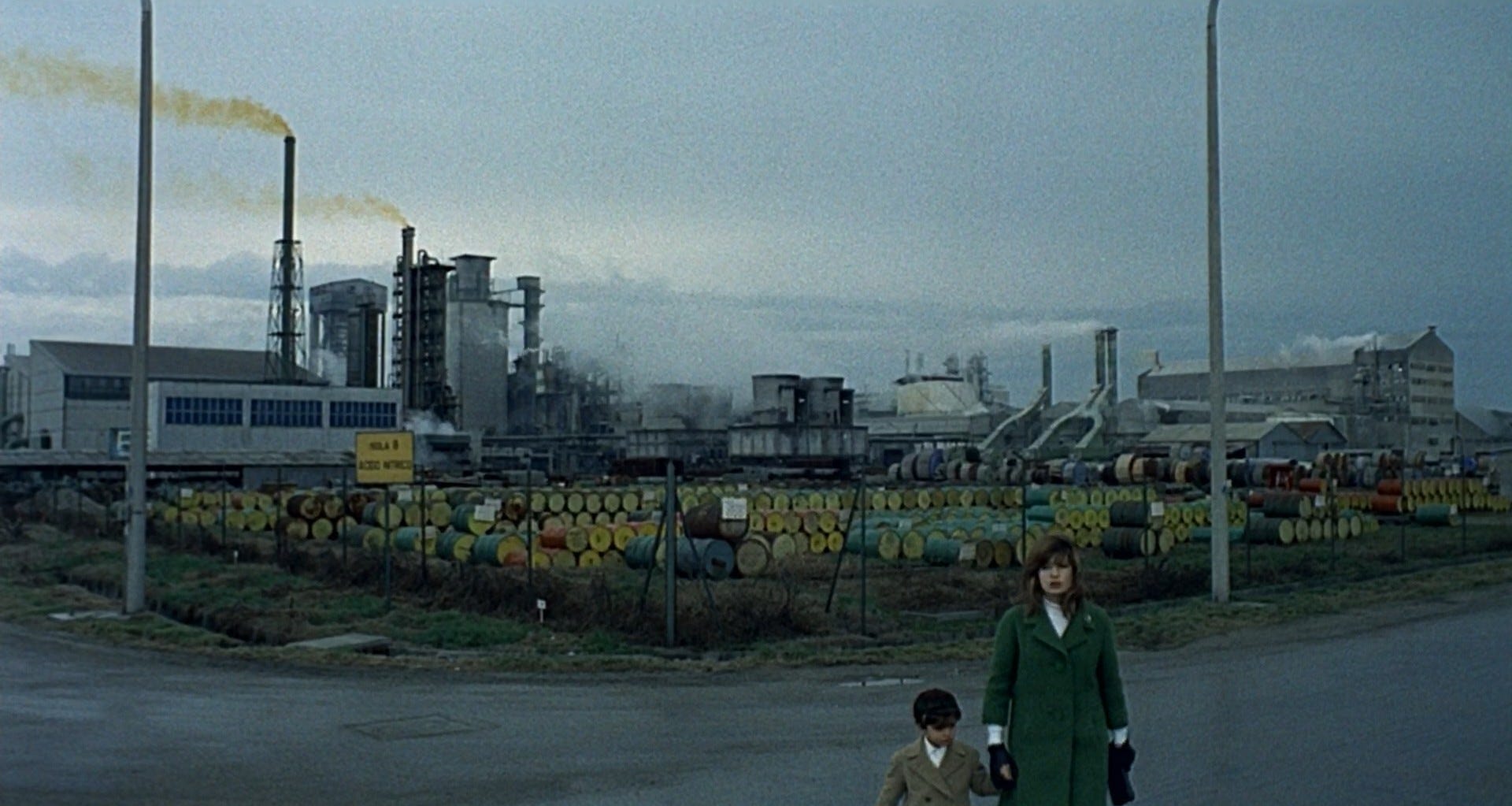
The desert and its colours. The imagery of the title sequence, with a focus on the significance of colours. The use of yellow in This is Not a Burial, It’s a Resurrection. The title Red Desert, as explained by Antonioni and as it occurs in Frisch’s Homo Faber (which appears in Corrado’s hotel room). Blurred imagery connected to smoke and fog. The credits for Tintal paint (discussion of 1960s Tintal adverts) and the pink beach on the island of Budelli.
Noise and noise-music. The layered soundtrack in the title sequence. Luigi Russolo’s futurist manifesto, The Art of Noises. Musique concrète by Schaeffer and Stockhausen. Antonioni’s notes on the soundscape of New York. Gelmetti’s music for Red Desert, combining factory drones and electronic sound effects. Comparison with the Tardis sound effect in Doctor Who.
Robotic and human songs. The relationship between Gelmetti’s electronic music and Fusco’s song. Sound design in The Conversation and the paranoia of being surrounded by inhuman things. Electronic music/effects in Stalker and Forbidden Planet. The title music in L’eclisse. More comparisons with Schaeffer. Contrast with Fusco’s music in Il grido. Challenges of identifying origins and destinations (of sounds, images, people) in L’avventura, L’eclisse, Blow-Up, and Zabriskie Point. The transition from the end of Red Desert’s title sequence to the flare stack in the first scene.
Outside the factory. The establishing shots of the first scene. Conflicts between the omnipotent camera-eye and Giuliana’s point of view. What is the film’s attitude to Giuliana? Antonioni on the beauty of factories compared to that of pine forests. Competing perspectives in the title sequence of La notte. Comparison with the elevator shot in Beyond the Clouds. Contrasting portrayals of industrial action in Red Desert and Il grido.
The scab, the sandwich, and the slag-heap. Introduction to Giuliana. Her alienation from the crowd of striking workers. Comparisons with crowd scenes in Cléo from 5 to 7 and Chung Kuo: Cina, and with Lidia’s solitary walk in La notte. Giuliana’s food scavenging compared to Les rendez-vous d’Anna. Protest and social isolation in Umberto D. Giuliana compared with Irene in Europa ’51 in terms of mother/son relationship and attitude to social injustice. Valerio compared to Addie in Paper Moon and pod people in Invasion of the Body Snatchers. The slag-heap in Red Desert and T. S. Eliot’s Waste Land.
Inside the factory. Transition from the first to the second scene. The factory tour: colours, artworks, workers’ emotions, camera angles. Comparisons with Metropolis, Strike, Forbidden Planet, Europa ’51, Blue Collar, Human Resources, Zabriskie Point, and The Scar.
The cloud of steam. Ugo and Corrado’s encounter with the cloud of steam in the factory courtyard. Flames, ventilations, steam, and smoke in the industrial world. The motif of disappearing people in Antonioni’s films. Adaptation and transformation in the modern world. The cloud of steam as the ‘nightmare’ from which Giuliana wakes up in the next scene. Comparisons with towering edifices and industrial by-products in Metropolis, Sette canne un vestito, Les visiteurs du soir, and Stalker. Corrado’s alienation from his job; alienation from labour, obscured images, inter-generational conflict, and the spirit of rebellion in Killer of Sheep, Blow-Up, Pather Panchali, L’avventura, and The Working Class Goes to Heaven.
The ‘love’ triangle. The relationship(s) between Giuliana, Ugo, and Corrado. Conventions and clichés of love triangles, how jealousy is expressed, how lovers look at each other. Antonioni’s description of Corrado ‘taking advantage’ of Giuliana. Comparisons with Story of a Love Affair, This Sporting Life, The Lovers, L’eclisse, La signora senza camelie, Beyond the Clouds, and L’avventura. Ugo’s embarrassment over Giuliana’s indecorous behaviour, and Corrado’s reaction to this; comparison with A Woman Under the Influence.
Night terrors. Giuliana’s angst-ridden home environment. Her night terrors associated with the heat, fire, and steam of the factories. Valerio’s sinister robot guardian. The horror lurking downstairs; comparison with Karin’s encounter with ‘God’ in Through a Glass Darkly. High-pitched tones on the soundtrack, revelations of hidden realities; comparisons with Zabriskie Point, They Live, The Devil’s Trap, and Seconds. Furniture (the Dante Chair) and paintings (Valerio’s and Gianni Dova’s) in Giuliana’s home. Giuliana’s discomfort in her environment compared with the hospital patient in La notte, Buster Keaton in Our Hospitality, and Hanna Wendling in The Sleepwalkers.
Familial terrors. Giuliana’s troubled relationships with Valerio and Ugo. Valerio’s paintings and Gianni Dova’s Rite of Spring as commentaries on Giuliana’s domestic alienation. Dova’s connection to the Nuclear and Spatialist movements; comparisons with paintings by Enrico Baj and Lucio Fontana, including the latter’s Red Desert-inspired Concetto spaziale. Valerio and Ugo resemble Baj’s ultracorpi and pod people. Space and dimensions in Dova’s Rite of Spring, Botticelli’s Primavera, and Seconds. Body horror in The Red Shoes and ‘I Have No Mouth and I Must Scream’. Hanna Wendling’s alienation from her son in The Sleepwalkers. Sexual assault and impulsive/abusive male sexuality in L’avventura, La notte, and Red Desert.
Desert spaces. The Via Pietro Alighieri as an archaic desert space. The effect of the transition from Dova’s Rite of Spring to the wall at the start of this sequence; comparison with disorienting images in Identification of a Woman. The Via Alighieri’s resemblance to de Chirico paintings. The deserted town in L’avventura. Clara’s favourite desert space in La signora senza camelie. Alienated lovers’ ‘deserts’ (expansive and cramped) in Story of a Love Affair, Le amiche, and L’avventura. How other Antonioni characters use desert spaces, especially in The Passenger, Blow-Up, I vinti, Identification of a Woman, and ‘Report about myself’. The stray newspaper in Red Desert; comparisons with newspapers in L’eclisse and The Red Shoes.
The fruit-seller. Giuliana’s disturbing encounter with the grey old man and his fruit-cart. The dolly shot in the deserted town in L’avventura. Subjective and objective points of view. Flavio Niccolini’s account of the fruit-seller scene in Red Desert: Monica Vitti’s fear of Tanino. Comparison with the grey memory pit in Inside Out. Giuliana inhabits a marginalised, discarded space, but is out of place here too. Clelia’s alienation from Turin (and Carlo) in Le amiche. Antonioni’s sense of class, time, and place in ‘Report about myself’.
Celeste e verde. Giuliana’s work ethic compared with Clelia’s and Rosetta’s in Le amiche and Among Women Only. Giuliana’s preferred colours for her ceramics shop, and the significance of Celeste e verde, the working title of Red Desert. Common themes across Antonioni film titles: Story of a Love Affair, Le amiche, L’avventura, Blow-Up, Zabriskie Point, and Identification of a Woman. Extended analysis of Lo sguardo di Michelangelo as a reflection on Antonioni’s gaze and his relationship with the other Michelangelo’s sculptures; comparisons with the old man at the end of L’eclisse, the lions in Battleship Potemkin, and Claudia’s gesture at the end of L’avventura. Empty and/or reflective screens and bodies of water in La notte and Gente del Po; how these relate to the colour-swatches on the wall of Giuliana’s shop. The shop-worker in ‘The girl, the crime’ and Beyond the Clouds.
The beginning of the affair. Giuliana’s dialogue with Corrado about her plans for the shop, and the underlying dynamics of their first proper interaction. Corrado’s sense of place compared with Verushka’s in Blow-Up. Contrast with Richard Harris’s performance (and character) in This Sporting Life; Frank’s relationship with Margaret and Corrado’s with Giuliana. Empty performances in ‘Il provino’ and La signora senza camelie.
The growth of the affair. Giuliana accompanies Corrado to Ferrara and Medicina. Their relationship develops towards something like an ‘affair’, under the pressure of codes and clichés that may be at odds with what Giuliana wants. Brief encounters in Le amiche and L’avventura. Roland Barthes on Antonioni’s ‘dead times’ and the distinction between truth and meaning; the ambiguous meaning of ‘The girl, the crime’. Corrado’s seduction as tacky manipulation and artifice; Sunny Dunes and the exploding objects in Zabriskie Point. The ‘if I loved you’ dialogues in Red Desert and ‘A film to be made (or not made)’. Corrado resembles the resentful men in Le amiche and L’avventura. Red Desert as a re-working of noir love triangles in Ossessione and Story of a Love Affair; the latter’s use of Massimo Girotti compared with Ossessione and Theorem; Red Desert’s use of Richard Harris compared with This Sporting Life. Antonioni’s comments on Bicycle Thieves and ‘the problem of the bicycle’; how these help to explain his approach to the ‘adultery drama’.
Giuliana’s illness. What we learn about Giuliana’s illness during her trip with Corrado. Doctors in the clinic telling her ‘how to love,’ her dialogue with her other self, her loss of solid ground. People conflated with inanimate objects in L’eclisse. Problematic relationships with the self (and representations or reflections of the self) in La signora senza camelie, Dova’s Rite of Spring, Bellissima, Senso, and Among Women Only. Giuliana’s dialogue with Mario against the red girders compared with T. S. Eliot’s ‘nerves in patterns on a screen’ in The Love Song of J. Alfred Prufrock.
The daytrip gone wrong. The trip to the swamp and Max’s shack. Failed leisure activities in I vinti, Le amiche, L’avventura, and La notte. Critique of Pauline Kael’s reviews of La notte and Red Desert. Daytrips and desert spaces: what is revealed during leisure time. The polluted swamp; ‘effluent has to go somewhere.’ Giuliana’s fascination with this place, and with the ship that seems to sail through the forest.
Industry, exploitation, and ‘Sick Eros’. The get-together in Max’s shack. Industrial fatalism linked to erotic fatalism; comparison with Sandro in L’avventura. Misogynistic shaming of Mili; her fear of and contempt for Max, whom she calls out as an economic and sexual predator; Giuliana’s reaction to this. A bleak mood offset by moments of seeming liberation. Antonioni’s ‘Eros is sick’ statement from the Cannes premiere of L’avventura. Ambiguous portrayals of emotional or sexual liberation in Blow-Up, Makaroni (un-filmed Antonioni story), L’avventura, and Zabriskie Point. Max’s red room; a reference back to the use of red in Mario’s apartment (and to Fontana’s Concetto spaziale); red, grey, and pink in L’innocente.
Something terrible in the fog. The cry of agony outside Max’s shack; the resulting controversy when only Linda and Giuliana have heard it. The effects of fog in ‘That bowling alley on the Tiber’; the significance of the Dantean classical simile used to describe the creative process in that story. The malattia dei sentimenti as portrayed in Il grido, and the significance of the titular ‘cry’. An un-filmed exchange from L’avventura about Anna having ‘perhaps simply drowned.’ The fog-shrouded confrontation on the pier in Red Desert compared with the confrontation between Vittoria and Riccardo at the start of L’eclisse.
Corrado’s philosophy. Corrado’s speeches, during the daytrip sequence, about his attitudes to life, politics, and work. Antonioni’s comments about Africa; the blackface dance in L’eclisse; Locke’s documentary about Africa in The Passenger; the portrayal of colonialist attitudes in Emitaï and Soleil Ô. Calvino’s The Watcher (which appears later in the hotel room) provides an analogue for Corrado.
How to see and how to live. The dialogue, in Max’s shack, between Giuliana and Corrado; comparison with dialogue between Lermontov and Vicky in The Red Shoes; the dangerous fusion of life and art. Antonioni’s conception of women as ‘subtle and uneasy filters of reality’; connections with Niccolò in Identification of a Woman and Amerigo in The Watcher. The eclipse that inspired L’eclisse, how life is shaped by how things look. Revelry followed by melancholy in PlayTime, Daisies, and Soleil Ô; what these films say about looking and living. Claudia pulling faces in L’avventura.
Valerio and the chemistry set. The transition to Giuliana’s apartment and the aftermath of the incident on the pier. Valerio’s STEM-focused bedroom and the bond between him and Ugo, which excludes Giuliana. The ‘one plus one’ trick. Nicole Diver’s resentment of her husband and children in Tender is the Night (and Fitzgerald’s resentment of Zelda). Giuliana’s ambiguous embrace of Valerio; comparisons with parental embraces in The Babadook, Time Out, Carrie, and The Shining.
The suitcase and the gyroscope. Giuliana’s farewell to Ugo. Comparison with the portrayals of marriages/relationships in crisis in The Dead, Journey to Italy, L’avventura, and La notte. Red Desert as a mirror-and-reversal of Journey to Italy. What do people die for, and if they survive, what do they live for (e.g. in Rome, Open City)? The effect on Giuliana’s marriage of her confrontation with mortality. Valerio’s gyroscope and the gyroscopes used to enable the penultimate shot of The Passenger.
The island of SAROM. Giuliana and Corrado on the offshore rig, surrounded by industrial structures and the ocean. Italian newsreel from 1962 celebrating the SAROM rig and industry-inspired art. Exclusion of the artisanal in Sette canne un vestito and Metropolis. Red Desert’s status as a petrochemical product. Striving for harmony with one’s surroundings; Vittoria rearranging objects behind a frame in L’eclisse; Giuliana taking her place behind a frame on the SAROM rig. Breaking up space with the propeller in Blow-Up. Giuliana and Corrado discuss travel and luggage; leaving people and finding them changed in L’avventura. The marginality of the SAROM workers; comparison with street-cleaners in N.U., Mandabi, and Soleil Ô. The alienated wagoner in Borom Sarret; central Dakar recalls the Rome of L’eclisse.
The story of the incident. The revelation of Giuliana’s attempted suicide. Intimacy and distance between her and Corrado. Comparison with adultery drama in Ossessione. ‘Attempted Suicide’ (Antonioni’s segment of Love in the City): doubts cast on the women’s stories, the artifice of film studios and re-enactments (cf. La signora senza camelie); Antonioni’s interest in self-annihilation, rather than suicide as such (evidenced in several films, including Beyond the Clouds and L’avventura). Giuliana discusses the clinic and contrasts herself with Mario. Treatment of suicide-by-water in The Crew (un-filmed Antonioni story) and Le amiche; significance of rivers in Gente del Po and ‘That bowling alley on the Tiber’.
Briefing the workers. Corrado addresses the recruits for his South American project. Power imbalances between workers and management. The camera ‘maps’ the warehouse from different perspectives, becoming distracted from the human elements and drawn towards the inanimate ones, as in the ending of L’eclisse or the film studio scenes in ‘Il provino’. The disgruntled workers of Red Desert contrasted with those of The General Line.
Shifting focus. Corrado evades the workers’ questions and becomes distracted. Antonioni’s comments on Corrado. The dehumanising capitalist gaze in Pigsty. Immobile spectators at the Yardbirds concert in Blow-Up, the pursuit and abandonment of the guitar-neck; altered contexts and loss of meaning. Akerman’s dehumanising camera in News From Home, seeking out places and images devoid of people, landscapes of the mind.
What Corrado sees and feels. The final two shots inside the warehouse and the transition to the courtyard. Corrado and the workers look at each other and fail to connect. Pasolini’s discussion of the Antonioni-Giuliana perspective and the ‘insane pan’ that follows the blue line up the warehouse wall. Mysterious poetic connections in Un chien Andalou, Theorem, and Pigsty. Light and colour effects to evoke a state of mind in The Color of Jealousy (un-filmed Antonioni story). The blue demijohns outside the warehouse in Red Desert.
The disintegration of values. Hermann Broch’s The Sleepwalkers appears in La notte and is a focal point for that film’s exploration of ‘values’. Roberto’s quotation from The Man Without Qualities and the significance of Giovanni’s response. Broch’s comments on style and ornament; the existential dread induced by bad or ornament-less architecture (cf. L’eclisse and Borom Sarret); Antonioni’s characters’ fear of transience. Ugo and Corrado as manifestations of their era. The singleness of purpose in the modern world. Claudia agonises over changing sentiments in L’avventura. Giuliana’s ‘neurosis’ as a justified response to her environment. Broch’s vision of descending to ‘absolute zero’ and achieving renewal; Antonioni’s more pessimistic vision; the disintegration of values on an interpersonal level in La notte.
Alienation and loneliness. Interpersonal alienation in Broch and Antonioni. Breaking free of conventions and slipping into confusion; the arbitrariness of Giuliana’s relationship with Corrado in Red Desert; the frustratingly easy shifts in feeling in L’avventura; the surreal sense of distance between people in L’eclisse; analogues in The Sleepwalkers. Broch’s optimism in The Death of Virgil, where interpersonal alienation is redeemed by honest communication and ‘mutual intuition.’ Antonioni’s comments about photographing layers of reality; the ending of Beyond the Clouds; the final revelation always out of reach.
Loneliness and childhood. Broch’s comments on childhood in The Sleepwalkers, as they relate to the childhood-centred aspects of Red Desert. Marguerite’s and Valerio’s seeming callousness as a way of coming to terms with loneliness; comparison with ‘Two telegrams’. Sleepwalking as a response to the modern age’s singleness of purpose. Giuliana and Valerio compared with Aldo and Rosina in Il grido (especially the encounter with the asylum inmates) and Antonio and Bruno in Bicycle Thieves.
Valerio’s paralysis. Valerio as a robot, shutting his mother out, or as a neglected child crying out for help; Bettelheim’s case-study of ‘Joey the Mechanical Boy’. Giuliana’s guilt compared with Laura’s in Brief Encounter. Valerio’s paralysis as a commentary on Giuliana’s illness, or on his environment; Samuel in The Babadook; Cecilia’s defensive behaviours in The Night of the Shooting Stars; Edmund in Germany Year Zero; Ana in Cría Cuervos. Giuliana’s wounded response to Valerio’s trick; her ‘Why?’ compared with Sandro’s and Anna’s ‘Why?’ in L’avventura.
A story for Giuliana. The tale of the pink beach: why it might (but probably does not) appeal to Valerio; why it might instead be tailored to suit Giuliana’s needs. How the story relates to sexuality and fear of the camera’s objectifying gaze. Unsustainable nostalgic fantasies; contrast with Daughters of the Dust, Cría Cuervos, and Germany Year Zero.
The ship and the song. How Giuliana’s tale is deconstructed from within by the two ‘mysteries’. The dream of continuity; how this is portrayed hopefully in Daughters of the Dust, and how Red Desert twists it into a nightmare. The disorienting edit when the surf laps the shore; comparison with Last Year at Marienbad, Le bonheur, and Blow-Up. The song recalls the title sequence and exposes this tale as an unsustainable fantasy; the fantasy morphs back into ‘reality’. Comparison with the self-deconstructing stories of escape in 8½ (contrasted with L’eclisse) and Identification of a Woman.
The journey to the hotel. Giuliana runs from Valerio to Corrado’s hotel. The malevolent world outside; the use of the zoom lens here and in Chung Kuo: Cina; Wenders’ objection to the zoom while making Beyond the Clouds. The all-white hotel foyer compared to the all-grey Via Alighieri, the hospital in La notte, and the psychoanalytic re-enactments in Secrets of a Soul. Giuliana’s disintegration while talking to the receptionist. Her journey along the hotel corridor compared with corridor imagery in Alphaville; Godard’s futuristic imagery compared with Cinecittà in ‘Il provino’. Parallel lines and vanishing points in N.U., Story of a Love Affair, and I vinti.
An incurable need. Giuliana’s dialogue with Corrado upon entering his hotel room. Neediness (and its absence) in Le amiche, Among Women Only, and L’avventura. Giuliana’s ‘wall of loved ones’ compared with the circus ring at the end of 8½. Unsettling sound and lighting effects in Corrado’s hotel room. ‘I am not cured, I will never be cured’; ‘You can’t get rid of the Babadook.’ Adriano Zanni’s Sequenze di fabbrica portrays an interior response to the hotel room scene through still photography and electronic music; comparison with electronic music in Identification of a Woman. Giuliana’s ‘affair’ with Corrado contrasted with portrayals of adultery and sexuality in Madame de…, La ronde, Eyes Wide Shut, and Dream Story.
Giuliana and her environment. Giuliana interacts with the décor of Corrado’s hotel room. Corrado’s belongings, especially his books and his map. The relationship between Giuliana’s ‘madness’ and her environment; Antonioni’s focus on symptoms rather than causes. Corrado’s increasingly physical attempts to soothe/control Giuliana. R. D. Laing and Loach’s Family Life.
What is Giuliana afraid of? Strange shapes and colours appear on the walls and ceiling of the hotel room, echoing the chalk-drawing in Valerio’s bedroom; comparison with the Babadook descending from the ceiling. Corrado’s objectifying gaze; men’s fixation on women’s legs in L’avventura. Violence and sexual insecurity in Identification of a Woman. Antonioni’s conception of women as ‘subtle and uneasy filters of reality.’ Giuliana’s frenzy compared with Doya’s in Devi.
What happens to Giuliana? Antonioni’s abuse of Lucia Bosè on the set of Story of a Love Affair. Ishiguro’s definition of story-telling and how this is complicated in the case of an abusive artist. Wenders’ concerns about the sex scenes in Beyond the Clouds. The hotel room scene in Red Desert is a rape scene, but how does the film invite us to respond to it? Antonioni’s hypocrisy and his comments on hypocrisy (re: Giovanni in La notte). How Red Desert plays into (or does not play into) rape myths; comparisons with Boudu Saved from Drowning, A Day in the Country, Gone with the Wind, The Double Life of Véronique, and On the Waterfront. Giuliana’s ‘stop’ gesture compared with Vicky’s in The Red Shoes. Reality and spatial relations become more confused as the hotel room scene progresses; comparisons with the cloud of steam and the blue line in the warehouse.
The transformation. The dream-like conclusion of the hotel room scene; the dream-like ending of Zabriskie Point. The bodies of Giuliana and Corrado are conflated, the room turns pink. Whole-room compositions in The Cabinet of Dr. Caligari, The Night of the Hunter, and The Parallax View. The blue nightmare in In the Mouth of Madness; the spider in Enemy. Colour effects in The Oberwald Mystery; the fading colour at the end of The House of Mirth. The transition from the pink hotel room to the street outside.
Two failed projects. In Giuliana’s empty shop, Corrado confronts her about her plans for the future. Giuliana’s outburst and how she is stalked by the camera. Her existential condition compared with Dino’s in Moravia’s La noia. The publicity still of Giuliana’s shop streaked with paint; Soraya in ‘Il provino’; Fontana’s Concetto spaziale. Abuse and coercion in La noia related to Corrado’s treatment of Giuliana.
Something terrible in reality. The influence of Musil’s The Man Without Qualities (which is quoted in La notte) on Red Desert. Giuliana’s efforts to reinsert herself into reality. Musil’s reflections on the modern age’s crisis of values compared with Broch’s and Antonioni’s. Embracing ‘something impossible in reality’ and discovering something both wonderful and terrible; comparison with Karin in Through a Glass Darkly.
Corrado’s exit. Giuliana tells Corrado he has not helped her, and he leaves. Frisch’s Homo Faber as a source for Red Desert’s title; Walter Faber as an analogue for Corrado. Emotional repression prompts a rejection of ‘womanish’ existential angst. Sabeth’s game of comparisons; ‘distortions’ of reality in Red Desert. Antonioni’s note about his indifference to the theme of incest in Homo Faber and The Man Without Qualities; comparison with ‘The event horizon’. Sexual violence and/or incest in L’avventura, La notte, ‘The girl, the crime’, Beyond the Clouds (reference to The Dead), and Identification of a Woman. The Matisse painting on the cover of Anna’s copy of Tender is the Night in L’avventura. Schlöndorff’s adaptation of Homo Faber (a.k.a. Voyager); critical responses to its treatment of incest. Giovanni’s encounter with the young woman in the hospital in La notte compared with Clarisse’s visit to the hospital in The Man Without Qualities.
The harbour. Giuliana flees to the Ravenna harbour. Antonioni’s comments on devising this scene after Richard Harris’s sudden departure. Establishing shots: the red-painted ship’s hull, the cables and poles, other mechanical objects. Giuliana’s vulnerable position; comparison with ‘framing’ imagery on the SAROM rig and in L’eclisse. Diegetic and non-diegetic sound in the harbour. Toxic water with sludge floating in it; comparison with The Docks of New York and the barrel of water in L’eclisse. Plane-crash wreckage in ‘The event horizon’; waste management in Soleil Ô and N.U.
Does this ship take people? The harbour as a liminal space where Giuliana will come to terms with her conflicting desires for attachment and escape. Her initial (attempted) dialogue with the Turkish sailor. Communication failures with strangers in The Passenger and L’avventura. Giuilana’s attempted escape compared with Karin’s in Stromboli; the contrasting endings of Germany Year Zero, Europa ’51, Il grido, and L’avventura.
Giuliana’s explanation. Giuliana retreats from the ‘penetrating gaze’ of the Turkish sailor; comparison with vaguely dangerous encounters in Il grido, L’avventura, and La notte. Giuliana explains what she is doing and why she cannot leave Ravenna. ‘The bodies are separated’; comparison with Poe’s ‘The Premature Burial’ and Eliot’s The Waste Land. A passage highlighted by Antonioni in his copy of The Man Without Qualities: when we become ourselves, we become separated from our ‘self’; comparison with Broch’s view of childhood in The Sleepwalkers and Clara’s alienation in La signora senza camelie.
Absurdity and the desert. Giuliana’s conclusion, ‘Everything that happens to me is my life,’ and its relationship with Camus’s The Myth of Sisyphus. The defiantly absurd choice to remain (and remain alive) in the desert. The triumphant liberation experienced by Sisyphus and by Meursault in The Stranger; contrast with Giuliana’s bleaker existential resignation. Ulrich in The Man Without Qualities as a closer analogue to Giuliana; the ‘narrative thread’ of life compared with ‘The dangerous thread of things’ (short story) and the discussion of ‘order’ in Identification of a Woman. The concept of ‘adventure’ in L’avventura and Sartre’s Nausea.
The artist and reality. Antonioni’s citation of Camus’s The Rebel: the artist should revolt against reality, imposing stability on change and reconciling the unique with the universal. Comparison with Broch’s comments on ‘style’ in The Sleepwalkers. Antonioni’s scepticism about the power of the gaze to impose stability in Lo sguardo di Michelangelo. Camus’s hopeful vision of collective experience likened to Europa ’51; contrasted with Giuliana’s increasing isolation and journey into darkness. The link between artistic creation and love. The fading of human sentiment in Il grido, L’avventura, and La notte. Encroaching fog and un-reality in Sartre’s Nausea and La signora senza camelie. A rejection of Camus’s artistic ‘consummation’, an embrace of Sartre’s inescapable present-ness; comparison with the ending of L’eclisse.
Re-inserted in reality. The transition from the harbour to the final scene among the factories. A note of calm but also cyclical repetition; echoes of imagery from the title sequence and first scene. Comparison with the endings of Time Out and The Babadook; Dar Williams on overcoming suicidal depression in ‘After All’. Re-insertion in reality expressed through shot composition and the use of reflective/transparent surfaces in Yi Yi, Eros + Massacre, La notte, and ‘The Dangerous Thread of Things’ (film). Giuliana among the factories compared with Irene in Europa ’51.
Our place in the red desert. Valerio and Giuliana in the final scene; his interest in the industrial complex and its by-products, her discomfort and disorientation. Use of low-angle shots here and in L’Atalante. The final encounter with the factories compared with the discovery of The Room in Stalker. Giuliana’s blurred vision of the yellow barrels: as in Homo Faber, any surface can turn into the red desert; as in Camus’s The Plague, pestilence manifests in intangible visions and sounds. Redemptive readings of Red Desert’s ending. Antonioni’s comments on the future in Room 666. This is Not a Burial, It’s a Resurrection and Mother, I Am Suffocating. This Is My Last Film About You illustrate the importance of eschewing or complicating redemption and articulating the condition of the space-less ‘lost person’.
Seen enough today. The ending of Red Desert compared with Dar Williams’s ‘Mark Rothko Song’. How we engage (or fail to engage) with ‘desperate’ art, how we talk (or fail to talk) about depression and suicide. Christopher Rothko’s critique of ‘Mark Rothko Song’; the distinctions he draws between Rothko’s art and Antonioni’s films. Antonioni’s preoccupation with both the outer and inner worlds, and the relationship between them; connecting with the emotions of La notte. The importance of art that honestly portrays loneliness and despair.
Films cited
8½
Alphaville
Le amiche
Andrei Rublev
Apocalypse Now
L’Atalante
‘Attempted Suicide’ (from Love in the City)
L’avventura
The Babadook
Battleship Potemkin
Bellissima
Beyond the Clouds
Bicycle Thieves
Blow-Up
Blue Collar
Le bonheur
Borom Sarret
Brief Encounter
Boudu Saved from Drowning
The Cabinet of Dr. Caligari
Carrie
Cesta
Un chien Andalou
Chung Kuo: Cina
Cléo from 5 to 7
The Conversation
Cría Cuervos
Daisies
‘The Dangerous Thread of Things’ (from Eros)
Daughters of the Dust
A Day in the Country
Devi
The Devil’s Trap
The Docks of New York
Double Indemnity
The Double Life of Véronique
L’eclisse
Emitaï
Enemy
Eros + Massacre
Europa ’51
Eyes Wide Shut
Family Life
Forbidden Planet
The General Line
Gente del Po
Germany, Year Zero
Gone with the Wind
Il grido
Homo Faber (a.k.a. Voyager)
The House of Mirth
Human Resources
Identification of a Woman
L’innocente
Inside Out
In the Mouth of Madness
Invasion of the Body Snatchers
Journey to Italy
Kes
Killer of Sheep
Last Year at Marienbad
The Lovers
Madame de…
Metropolis
Mandabi
Mother, I Am Suffocating. This Is My Last Film About You
News From Home
The Night of the Hunter
The Night of the Shooting Stars
La notte
N.U.
The Oberwald Mystery
On the Waterfront
Ossessione
Our Hospitality
Paper Moon
The Parallax View
The Passenger
Pather Panchali
Pigsty
PlayTime
The Postman Always Rings Twice
‘Il provino’ (from I tre volti)
Red Desert
The Red Shoes
Les rendez-vous d’Anna
Rome, Open City
Room 666
La ronde
The Scar
Seconds
Secrets of a Soul
Senso
Sette canne, un vestito
Lo sguardo di Michelangelo
The Shining
La signora senza camelie
Soleil Ô
Stalker
Story of a Love Affair
Strike
Stromboli
Theorem
They Live
This is Not a Burial, It’s a Resurrection
This Sporting Life
Through a Glass Darkly
Time Out
Umberto D
I vinti
Les visiteurs du soir
A Woman Under the Influence
The Working Class Goes to Heaven
Yi Yi
Zabriskie Point
Works cited (excluding films)
Alighieri, Dante, The Divine Comedy, World of Dante
Antonioni, Michelangelo, The Architecture of Vision, ed. Carlo di Carlo and Giorgio Tinazzi; American edition by Marga Cottino-Jones (Chicago: University of Chicago Press, 1996)
Antonioni, Michelangelo, ‘Concerning a Film about the River Po’, in Springtime in Italy: A Reader on Neo-Realism, ed. and trans. David Overbey (Hamden: Archon Books, 1979), pp. 79-82
Antonioni, Michelangelo, Quel bowling sul Tevere (Torino: Einaudi, 1983)
Antonioni, Michelangelo, et al., Screenplays of Michelangelo Antonioni, trans. Roger J. Moore, (London, Souvenir 1963)
Antonioni, Michelangelo, et al., Sei film (Torino: Giulio Einaudi, 1964)
Antonioni, Michelangelo, That Bowling Alley on the Tiber, trans. William Arrowsmith (Oxford: Oxford University Press, 1986)
Antonioni, Michelangelo, et al., Unfinished Business: Screenplays, Scenarios and Ideas, trans. Andrew Taylor, ed. Carlo di Carlo and Giorgio Tinazzi (New York: Marsilio Publishers, 1998)
‘Appunti per “Deserto rosso” [1963 - 1964]’, b. 8C/5, fasc. 41C, ArchivioAntonioni
‘Appunto per “Deserto rosso” e riflessioni incompiute su incesto in letteratura e sulla filosofia’, 8D239b., ArchivioAntonioni
Arendt, Hannah, ‘The Achievement of Hermann Broch’, The Kenyon Review 11.3 (1949), pp. 476-483
Arrowsmith, William, Antonioni: The Poet of Images, ed. Ted Perry (London: Oxford University Press, 1995),
Austen, Jane, Northanger Abbey, Project Gutenberg
Avishai, Tamar, ‘Dar Williams, Singer-Songwriter’, The Lonely Palette (podcast), 07 October 2022
Baj, Enrico, Nuclear Forms (1951), Two Children in the Nuclear Night (1956)
Bänziger, Hans, ‘Frisch as a Narrator’, in Perspectives on Max Frisch, ed. Gerhard F. Probst and Jay F. Bodine (Lexington, Kentucky: The University Press of Kentucky, 1982), pp. 43-74
Barthes, Roland, ‘Dear Antonioni…’, trans. Nora Hoppe, in L’avventura, ed. Seymour Chatman and Guido Fink (New Brunswick: Rutgers University Press, 1989), pp. 209-214; p. 211. French text quoted from Étyen Wéry’s website. Originally published as ‘Cher Antonioni’, Cahiers du Cinéma 311 (May 1980), pp. 9-11.
Benayoun, Robert, ‘Le désert rouge’, Positif 66 (1965), pp. 43-59
Benci, Jacopo, ‘Identification of a City: Antonioni and Rome, 1940–62’, in Antonioni: Centenary Essays, ed. Laura Rascaroli and John David Rhodes (London: Palgrave Macmillan, 2011), pp. 21-63
Berger, John, ‘The Metaphysician of Bologna: John Berger on Giorgio Morandi, in 1955’, ARTnews, November 2015 (originally published in ARTnews, February 1955)
Bernard, Renata and Steven Woodward (eds.), Krzysztof Kieślowski: Interviews (Jackson: University Press of Mississippi, 2016)
Bettelheim, Bruno, ‘Joey, a “Mechanical Boy”’, Scientific American 200 (1959), pp. 116-127
Bondanella, Peter, The Films of Roberto Rossellini (Cambridge: Cambridge University Press, 1993)
Bondavalli, Simona, Fictions of Youth: Pier Paolo Pasolini, Adolescence, Fascisms (Toronto: University of Toronto Press, 2015)
Botticelli, Sandro, Primavera (c. 1480), Uffizi Gallery
Broch, Hermann, The Death of Virgil (1945), trans. Jean Starr Untermeyer (Lebooks Editora, 2024)
Broch, Hermann, The Sleepwalkers, trans. Willa and Edwin Muir, 1947 (New York: Vintage International, 1996)
Brody, Richard, Everything is Cinema: the Working Life of Jean-Luc Godard (New York: Henry Holt and Company, 2008)
Brunette, Peter, The Films of Michelangelo Antonioni (Cambridge: Cambridge University Press, 1998),
Bruno, Giuliana, Atlas of Emotion: Journeys in Art, Architecture and Film (New York: Verso, 2007)
Butler, Michael, ‘Identity and authenticity in Swiss and Austrian novels of the postwar era: Max Frisch and Peter Handke’, in The Cambridge Companion to the Modern German Novel, pp. 232-248
Calabretto, Roberto, ‘The Soundscape in Michelangelo Antonioni’s Cinema’, The New Soundtrack 8.1 (2018), pp. 1-19
Callan, Michael Feeney, Richard Harris: Sex, Death and the Movies (London: Robson Books, 2003)
Calvino, Italo, ‘The Watcher’ (trans. William Weaver), in The Watcher and Other Stories (San Diego: Harvest, 1971), pp. 1-74
Cameron, Ian, and Robin Wood, Antonioni (revised edition) (New York: Praeger, 1971)
Camus, Albert, The Myth of Sisyphus (1942), trans. Justin O’Brien (London: Penguin, 2013)
Camus, Albert, The Plague (1947), trans. Stuart Gilbert (Tingle Books, 2021)
Camus, Albert, The Rebel (1951), trans. Anthony Bower (London: Penguin, 2013)
Camus, Albert, The Stranger (1942), trans. Stuart Gilbert (1946) (Philadelphia: R. P. Pryne, 2015)
Canby, Vincent, ‘Review/Film; A Variation on the Oedipus Theme’, The New York Times, 31 January 1992
Caputo, Rolando, Commentary track, Red Desert (DVD, Madman Entertainment 2006).
Casetti, Francesco, ‘Cinema in the cinema in Italian films of the fifties: Bellissima and La signora senza camelie’, Screen 33.4 (Winter 1992), pp. 375–393
Cassani, Alberto Giorgio, ‘Uno sguardo al nuovo libro di Adriano Zanni, tra documenti di civiltà e barbarie’, Ravenna e Dintorni (26 May, 2025)
Chatman, Seymour, Antonioni, or, The Surface of the World (Berkeley: University of California Press, 1985)
Coates, Paul, ‘On the Dialectics of Filmic Colors (in general) and Red (in particular): Three Colors: Red, Red Desert, Cries and Whispers, and The Double Life of Véronique’, Film Criticism 32.3 (2008), pp. 2-23
Dalle Vacche, Angela, The Body in the Mirror: Shapes of History in Italian Cinema (Princeton: Princeton University Press, 2014)
Dalle Vacche, Angela, Cinema and Painting: How Art is Used in Film (Austin: University of Texas Press, 1996)
Danchev, Alex, On Art and War and Terror (Edinburgh: Edinburgh University Press, 2009),
de Chirico, Giorgio, Piazza d’Italia, 1963, Mystery and Melancholy of a Street (1914), Piazza d’Italia, 1970, Piazza d’Italia (c. 1970), Sgombero su piazza d’Italia, 1968.
Deleuze, Gilles, Cinema 2: The Time-Image (1985), trans. Hugh Tomlinson and Robert Galeta (Minneapolis: University of Minnesota Press, 1989)
Demori, Lara, ‘Organicize disintegration: from Nuclear Aesthetics to Interplanetary Art’, Palinsesti 7 (2018) pp. 27-57
Dova, Gianni, Sagra della Primavera (1961), Collezione Ghigi-Pagnani
Dowden, Stephen D., Sympathy for the Abyss: A Study in the Novel of German Modernism: Kafka, Broch, Musil, and Thomas Mann (Tübingen: Max Niemeyer Verlag, 1986)
Ebert, Roger, ‘Voyager’ (review), (29 May 1992), rogerebert.com
Eliot, T.S., ‘The Love Song of J. Alfred Prufrock’ and ‘The Waste Land’ in The Complete Poems and Plays of T.S. Eliot (London: Faber, 2011)
Elwell, Frederick, The Wedding Dress (1911), Ferens Art Gallery, Kingston Upon Hull
Fitzgerald, F. Scott, Tender is the Night (1934 edition), ed. Arnold Goldman (London: Penguin, 2000)
Fontana, Lucio, Concetto spaziale, Attese (1965)
Fontana, Lucio, Manifesto Blanco (1946), 391.org
Forgacs, David, ‘Antonioni: Space, Place, Sexuality’, in Spaces in European Cinema, ed. Myrto Konstantarakos (Exeter: Intellect, 2000), pp. 101-111
Forgacs, David, Commentary track, Red Desert (Blu-Ray, BFI, 2008)
Forgacs, David, ‘Face, Body, Voice, Movement: Antonioni and Actors’, in Antonioni: Centenary Essays, ed. Laura Rascaroli and John David Rhodes (London: Palgrave Macmillan, 2011), pp. 167-182
Frisch, Max, Homo Faber, trans. Aloisio Rendi (1959) (Milan: Feltrinelli, 2005)
Frisch, Max, Homo Faber, trans. Michael Bullock (1959) (London: Penguin, 2006)
Gandy, Matthew, ‘Landscapes of deliquescence in Michelangelo Antonioni’s Red Desert’, Transactions of the Institute of British Geographers, New Series, 28.2 (2003), pp. 218-237
Gilliatt, Penelope, ‘A Great Week for British Cinema’, The Observer (10 February 1963)
Gilman, Richard, ‘About Nothing – with Precision’, in Common and Uncommon Masks: Writings on Theatre, 1961-1970 (New York: Random House, 1971), pp. 30-37; originally published in Theater Arts 46.7 (July 1962), pp. 10–12
Girish, Devika, ‘Devi: Seeing and Believing’, Criterion.com (26 October 2021)
Giuffrida, Angela, ‘Hermit guardian of Budelli dies after three decades on paradise island’, The Guardian (07 January 2025)
Godard, Jean-Luc, ‘The night, the eclipse, the dawn’, trans. Andrew Taylor, in The Architecture of Vision, ed. Carlo di Carlo and Giorgio Tinazzi; American edition by Marga Cottino-Jones (Chicago: University of Chicago Press, 1996), pp. 287-297
Godard, Jean-Luc, ‘La nuit, l’éclipse, l’aurore’, in Cahiers du Cinéma 160 (November 1964), pp. 8-17
Gundle, Stephen, Fame Amid the Ruins: Italian Film Stardom in the Age of Neorealism (New York: Berghahn, 2020)
Hamilton, Jack, ‘Antonioni’s America’, Look (18 November 1969), pp. 36-40
Heathcote, Christopher, ‘When Antonioni Met Rothko’, Quadrant (January-February 2012), pp. 84-89
Heinrich, Nathan, ‘The Pink Sand Beach: Sardinia Italy’, All Roads Lead to Italy (19 March 2024)
Helmetag, Charles H., ‘Volker Schlöndorff’s “American” Film Adaptation of Max Frisch’s “Homo faber”’, Monatshefte 87.4 (1995), pp. 446-456
Henderson, Christine, ‘The Trials of Individuation in Late Modernity: Exploring Subject Formation in Antonioni’s Red Desert’, Film-Philosophy 15 (2011), pp. 161-178
Hoffman, Cara, ‘Vanishing Point’, The Paris Review (06 March 2017)
Hook, Andrew, F. Scott Fitzgerald: A Literary Life (Gordonsville: Palgrave Macmillan, 2002)
Hopper, Edward, ‘Nighthawks’ (1942), Friends of American Art Collection
Hunt, A. E., ‘Lemohang Jeremiah Mosese: Contours in the Dust’, mubi.com, 13 January 2021
Ishiguro, Kazuo, ‘Nobel Lecture’ (2017), available on nobelprize.org
Jacobs, Steven, ‘Between EUR and L.A.: Townscapes in the Work of Michelangelo Antonioni’, in The Urban Condition: Space, Community, and Self in the Contemporary Metropolis, ed. the Ghent Urban Studies Team (Rotterdam: 010 Publishers, 1999), pp. 325-342
Jacobs, Steven, ‘Carving Cameras: Antonioni’s Lo sguardo di Michelangelo’, in Cinematic Intermediality: Theory and Practice, ed. Kim Knowles and Marion Schmid (Edinburgh: Edinburgh University Press, 2021), pp. 23-37
Joyce, James, Dubliners (1914), (London: Penguin, 2000)
Kael, Pauline, 5001 Nights at the Movies (New York: Henry Holt and Company, 1985)
Kael, Pauline, et al., ‘Films of the Year’, Film Quarterly 15.2 (1961-1962), pp. 35-37
Kael, Pauline, I Lost It at the Movies (London: Cape, 1966)
Kael, Pauline, Kiss Kiss Bang Bang (Boston: Little, Brown, 1968)
Kearns, Juli, ‘Analysis of Michelangelo Antonioni’s Blow-Up’, Idyllopus Press
Kinder, Marsha, ‘Zabriskie Point’, in The Architecture of Vision, ed. Carlo di Carlo and Giorgio Tinazzi; American edition by Marga Cottino-Jones (Chicago: University of Chicago Press, 1996), pp. 304-312
King James Bible, 1 Corinthians 13:12 (BibleGateway.com)
Kirkham, Victoria, ‘The Off-Screen Landscape: Dante’s Ravenna and Antonioni’s Red Desert’, in Dante, Cinema, and Television (Toronto: University of Toronto Press, 2004), pp. 106-128
Lannes, Sophie, Philippe Meyer, ‘Identification of a filmmaker’, in The Architecture of Vision, ed. Carlo di Carlo and Giorgio Tinazzi; American edition by Marga Cottino-Jones (Chicago: University of Chicago Press, 1996), pp. 245-256
‘La Settimana Incom: Numero unico dedicato a Ravenna e all’attività del porto. La raffineria di Sarom.’ Available on YouTube via the Istituto Luce online archive.
Letteri, Richard, ‘Becoming Giuliana: Antonioni’s Red Desert and the Capitalist Social Machine’, Deleuze and Guattari Studies 15.1 (2021), pp. 91-116
Lewis, Jo Ann, ‘Rothko: Not Nothing’, The Washington Post, 02 May 1998
Luzzi, Joseph, ‘The End of the Affair: Rossellini and Antonioni after Neorealism’, Raritan 33 (2013), pp. 105-119
Luzzi, Joseph, ‘Red Desert (Il deserto rosso) (review)’, Modernism/Modernity (18.1, 2011), pp. 205-209
Luzzi, Joseph, ‘Rossellini’s Cinema of Poetry: Voyage to Italy’, Adaptation 3.2 (2010), pp. 61-81
Manceaux, Michèle, ‘Dans le Désert rouge’, L’express (16 January 1964), pp. 19-21
Marchand, Jean José, ‘Interview with de Chirico’, trans. David Smith, Metaphysical Art 11-13 (2013), pp. 286-298
Marcus, Millicent, After Fellini: National Cinema in the Postmodern Age (Baltimore: Johns Hopkins University Press, 2002)
Marcus, Millicent, Italian Film in the Light of Neorealism (Princeton: Princeton University Press, 1986)
Martin, Adrian, ‘Voyager’ (review), (November 1993), adrianmartinfilmcritic.com
Masłoń, Sławomir, Secret Violences: The Political Cinema of Michelangelo Antonioni, 1960-75 (London: Bloomsbury Academic, 2023)
Matisse, Henri, Dancer and Rocaille Armchair on a Black Background (1942), private collection
McQuiston, Kate, We’ll Meet Again: Musical Design in the Films of Stanley Kubrick (Oxford: Oxford University Press, 2013)
Menduni, Enrico, ‘Il fiume Po tra cinema e fotografia: Transiti e ipotesi di lavoro’ (presentation slides), 02 May 2018
Messina, Maura, ‘Luisa Ranieri definita la nuova Sophia Loren si racconta: “Sono una timida…”’, Novella 2000, 13 February 2018
Morandi, Giorgio, Paesaggio (1934), Paese (1936), Still Life (1956)
Moravia, Alberto, ‘The American Desert’, trans. Carmen Di Cinque, in The Architecture of Vision, ed. Carlo di Carlo and Giorgio Tinazzi; American edition by Marga Cottino-Jones (Chicago: University of Chicago Press, 1996), pp. 298-303
Moravia, Alberto, Boredom (1960), trans. Angus Davidson (New York: The New York Review of Books, 1999)
Mosese, Lemohang Jeremiah, and Cait Pansegrouw, Commentary track, This Is Not a Burial, It’s a Resurrection (Blu-ray, Criterion 2023)
Mulkern, Patrick, ‘Doctor Who’s Brian Hodgson on how he created the Tardis and Dalek sounds’, Radio Times (29 July 2009)
Mulvey, Laura, ‘Vesuvian Topographies: The Eruption of the Past in Journey to Italy’, in Roberto Rossellini: Magician of the Real, ed. David Forgacs, Sarah Lutton, and Geoffrey Nowell-Smith (London: BFI Publishing, 2000), pp. 95-111
Musil, Robert, The Man Without Qualities (1930-1943), trans. Sophie Wilkins (Basingstoke: Pan Macmillan, 2017)
Musil, Robert, L’uomo senza qualità, trans. Anita Rho, vol. 2 (Torino: Einaudi, 1958)
Musil, Robert, L’uomo senza qualità, trans. Anita Rho, Gabriella Benedetti, and Laura Castoldi, ed. Adolf Frisé (Torino: Einaudi, 1997)
Nardelli, Matilde, ‘Some Reflections on Antonioni, Sound and the Silence of La notte’, The Soundtrack 3.1 (2010), pp. 11–23
Nardelli, Matilde, Antonioni and the Aesthetics of Impurity: Remaking the Image in the 1960s (Edinburgh: Edinburgh University Press, 2020)
Niccolini, Flavio, ‘Diary’ (1964), trans. Maggie Fritz-Morkin, Words Without Borders (02 March, 2011). The original Italian text is published in Michelangelo Antonioni, Il deserto rosso, ed. Carlo di Carlo (Bologna: Capelli, 1964)
Novak, Philip, Interpretation and Film Studies (Cham: Palgrave Macmillan, 2020),
Nowell-Smith, Geoffrey, L’avventura (London: British Film Institute, 1997)
Nudo, Meredith, ‘The Rothko Chapel’s Restoration Has a Long Road Ahead’, Houstonia (15 January 2025), photo credit: Anthony Rathbun
Orr, John, Contemporary Cinema (Edinburgh: Edinburgh University Press, 1998)
Pasolini, Pier Paolo, ‘Il cinema di poesia’, Scraps From the Loft (11 September, 2020)
Pasolini, Pier Paolo, ‘The Cinema of Poetry’, in Heretical Empiricism, ed. Louise K. Barnett, trans. Ben Lawton and Louise K. Barnett, (Bloomington: Indiana University Press, 1988), pp. 167-186
Pasolini, Pier Paolo, Teorema (Milano: Garzanti, 1968)
Pasolini, Pier Paolo, Theorem, trans. Stuart Hood (New York: New York Review Books, 1992)
Past, Elena, Italian Ecocinema: Beyond the Human (Bloomington: Indiana University Press, 2019)
Paulicelli, Eugenia, Italian Style: Fashion and Film from Early Cinema to the Digital Age (New York: Bloomsbury Academic, 2016)
Pavese, Cesare, Among Women Only (1949), trans. D. D. Paige (London: Peter Owen, 1953)
Pavese, Cesare, Tra donne sole (Torino: Einaudi, 1998)
Peterson, Thomas E., Alberto Moravia (New York: Twayne, 1996)
Pinkus, Karen, ‘Antonioni’s Cinematic Poetics of Climate Change’, Antonioni: Centenary Essays, ed. Laura Rascaroli and John David Rhodes (London: Palgrave Macmillan, 2011), pp. 254-275
Poe, Edgar Allan, ‘The Premature Burial’, Project Gutenberg
Pomerance, Murray, ‘Notes on Some Limits of Technicolor: The Antonioni Case’, Senses of Cinema 53 (2009)
Pomerance, Murray, Michelangelo Red Antonioni Blue: Eight Reflections on Cinema (Berkeley: University of California Press, 2011)
Quaresima, Leonardo, ‘“Making Love on the Shores of the River Po”: Antonioni’s Documentaries’, in Antonioni: Centenary Essays, ed. Laura Rascaroli and John David Rhodes (London: Palgrave Macmillan, 2011), pp. 115-133
Rascaroli, Laura, The Personal Camera: Subjective Cinema and the Essay Film (New York: Wallflower Press, 2014)
Restivo, Angelo, ‘Revisiting Zabriskie Point’, in Antonioni: Centenary Essays, ed. Laura Rascaroli and John David Rhodes (London: Palgrave Macmillan, 2011), pp. 82-97
Restivo, Angelo, The Cinema of Economic Miracles: Visuality and Modernization in the Italian Art Film (Durham: Duke University Press, 2022)
Rhodes, John David, ‘Antonioni and The Development of Style’, in Antonioni: Centenary Essays, ed. Laura Rascaroli and John David Rhodes (London: Palgrave Macmillan, 2011), pp. 276-300
Richter, Gerhard, Forest Piece (1965), Landscape (1965), Landscape Near Hubbelrath (1969), 18 October 1977 (1988)
Rifkin, Ned, Antonioni’s Visual Language (Ann Arbor: UMI Research Press, 1982)
Rohdie, Sam, Antonioni (London: British Film Institute, 1990)
Rothko, Christopher, Mark Rothko: From the Inside Out (New Haven: Yale University Press, 2015)
Rothko, Mark, Untitled (sometimes exhibited as Untitled (Blue, Green)) (1968), Harvard Art Museums / Fogg Museum; Untitled (Green on blue) (1956), Art Museum of the University of Arizona, Tempe; Untitled (Green on Blue) (1968)
Russolo, Luigi, The Art of Noises (1913), trans. Barclay Brown (New York: Pendragon Press, 1986)
Samuels, Charles Thomas, ‘Michelangelo Antonioni’ (29 July 1969), in Encountering Directors (New York: Capricorn Books, 1972), pp. 15-32; also available via Scraps From the Loft
Sartre, Jean-Paul, Nausea (1938), trans. Robert Baldick (London: Penguin, 1990)
‘Scena del film “Il deserto rosso”’, from the photography archive on the Regione Lombardia website
Schaeffer, Pierre, Five Noise Studies (1948)
Schlöndorff, Volker, ‘The Last Days of Max Frisch’, New York Times Book Review (05 April 1992)
Schnitzler, Arthur, Dream Story (1926), trans. J.M.Q. Davies (London: Penguin Books, 1999)
Schoonover, Karl, ‘Antonioni’s Waste Management’, in Antonioni: Centenary Essays, ed. Laura Rascaroli and John David Rhodes (London: Palgrave Macmillan, 2011), pp. 235-53
Schrader, Paul, ‘Color’, Film Comment 51.6 (2015), pp. 52-56
Schrader, Paul, Commentary track, Blue Collar (Blu-Ray, Indicator, 2018)
Schulman, Peter, ‘“Fragmegration” of Identity in Laurent Cantet’s Ressources Humaines and L’Emploi du Temps’, Cincinnati Romance Review 43 (2017), pp. 90-106
Shakespeare, William, The Merchant of Venice, The Folger Shakespeare
Shakespeare, William, Troilus and Cressida, The Folger Shakespeare
Sickert, Walter, ‘Le Lit de Cuivre’ (c. 1906); ‘Nude Figure Reclining’ (1912)
Steimatsky, Noa, Italian Locations: Reinhabiting the Past in Postwar Cinema (Minneapolis: University of Minnesota Press, 2008)
Steimatsky, Noa, ‘The Antonioni Screen-Test’, Framework 55.2 (2014), pp. 191-219
Steimatsky, Noa, The Face on Film (New York: Oxford University Press, 2017)
Stockhausen, Karlheinz, ‘Klavierstucke IX’; ‘Studie II’
Stubbs, John C., Federico Fellini as Auteur: Seven Aspects of His Films (Carbondale: Southern Illinois University Press, 2015)
Tait, Olivia, ‘Lucio Fontana’s Tagli’, Hauser & Wirth, 06 February 2019
TLO (username), ‘Antifouling paint’ (thread), encyclopedia-titanica.org
Tomasulo, Frank P., and Jason Grant McKahan, ‘“Sick Eros”: The Sexual Politics of Antonioni’s Trilogy’, Projections 3.1 (2009), pp. 1-23
van Gogh, Vincent, ‘Factories at Clichy’
Vasari, Giorgio, Six Tuscan Poets (1543-1544), Minneapolis Institute of Art
Vourlias, Christopher, ‘Director Lemohang Jeremiah Mosese: Africa Is “In the Process of Becoming”’, Variety, 02 December 2019
Weiler, A. H., ‘Screen: “This Sporting Life” Arrives’, The New York Times (17 July 1963)
Wenders, Wim, My Time with Antonioni, trans. Michael Hofmann (London: Faber and Faber, 2000)
White, Armond, Alex Cox, ‘Slaughterhouse blues: Charles Burnett on Killer of Sheep’, Sight and Sound 12.7 (Jul 2002), pp. 28-30
Whitman, Beth, ‘Dar Williams – Singer-songwriter’, She’s Bold with Beth Whitman (podcast), 01 April 2019
Willan, Philip, ‘Michelangelo’s lost statue finally dusted off’, The Guardian, 09 April 1999
Williams, Dar, ‘After All’, The Green World (Razor & Tie, 2000)
Williams, Dar, ‘Mark Rothko Song’, The Honesty Room (independently released 1993, re-released by Razor & Tie 1995); previously on All My Heroes Are Dead (independently released 1991)
Yang, Edward, and Tony Rayns, Commentary track, Yi Yi (Blu-Ray, Criterion Collection 2017)
Youngman, Paul A., ‘Cybernetic Flow, Analogy, and Probability in Max Frisch’s Homo Faber’, in A Companion to the Works of Max Frisch, ed. Olaf Berwald (Rochester, New York: Camden House, 2013), pp. 140-155
Zanni, Adriano, Sequenze di fabbrica (Boring Machines, 2024), Book and music available via Bandcamp