

This post contains some discussion of suicide.
In her final words to the Turkish sailor, Giuliana describes the mindset she intends to adopt from now on:
I have been ill, yes. But I shouldn’t think about it [non devo pensarci]. That is, I should think that everything that happens to me [tutto quello che mi capita] is my life. There it is [Ecco].
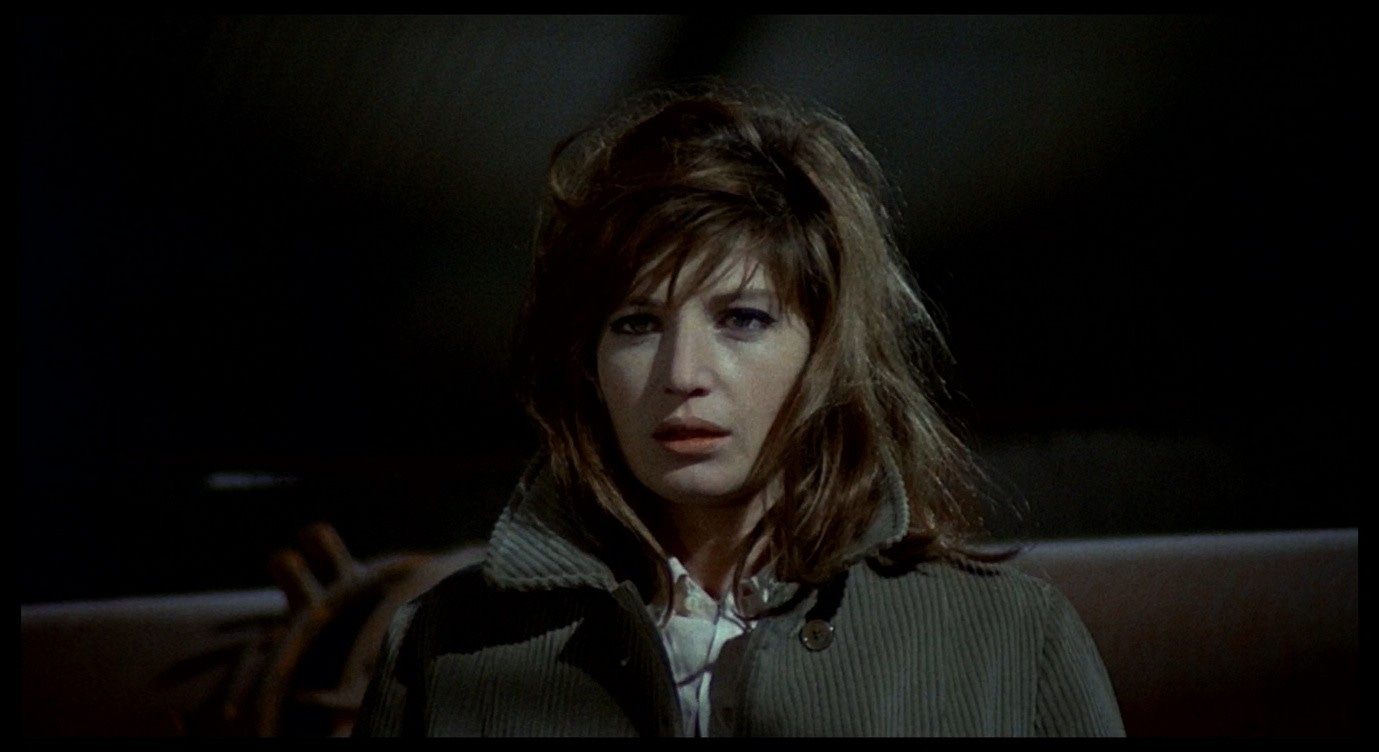
The idea of ‘not thinking about’ a problem recalls her final conversation with Corrado, in which he advised her, ‘You shouldn’t think these things [Non devi pensare queste cose],’ and she replied sarcastically, ‘Sure, just don’t think about it [basta non pensarci]. Beautiful conclusion [Bella conclusione].’ When she says non devo pensarci to the sailor, Giuliana has not simply internalised Corrado’s advice: she reiterates it but then amends it, specifying in positive terms what she ought to think. The idea Giuliana is now required to internalise is about the external forces that impact her. It is not a question of ‘not thinking about’ her illness, but of re-framing it as something that happens to her and that she defines as ‘her life.’
Albert Camus, one of Antonioni’s favourite writers, outlined a philosophy similar to the one Giuliana adopts. The philosophy is rooted in a conception of the absurd, defined in terms of contradiction in Camus’s essay The Myth of Sisyphus:
‘It’s absurd’ means ‘It’s impossible’ but also ‘It’s contradictory.’ If I see a man armed only with a sword attack a group of machine-guns, I shall consider his act to be absurd. But it is so solely by virtue of the disproportion between his intention and the reality he will encounter, of the contradiction I notice between his true strength and the aim he has in view. Likewise we shall deem a verdict absurd when we contrast it with the verdict the facts apparently dictated. […] [T]he feeling of absurdity does not spring from the mere scrutiny of a fact or an impression, […] it bursts from the comparison between a bare fact and a certain reality, between an action and the world that transcends it. The absurd is essentially a divorce. It lies in neither of the elements compared; it is born of their confrontation.1
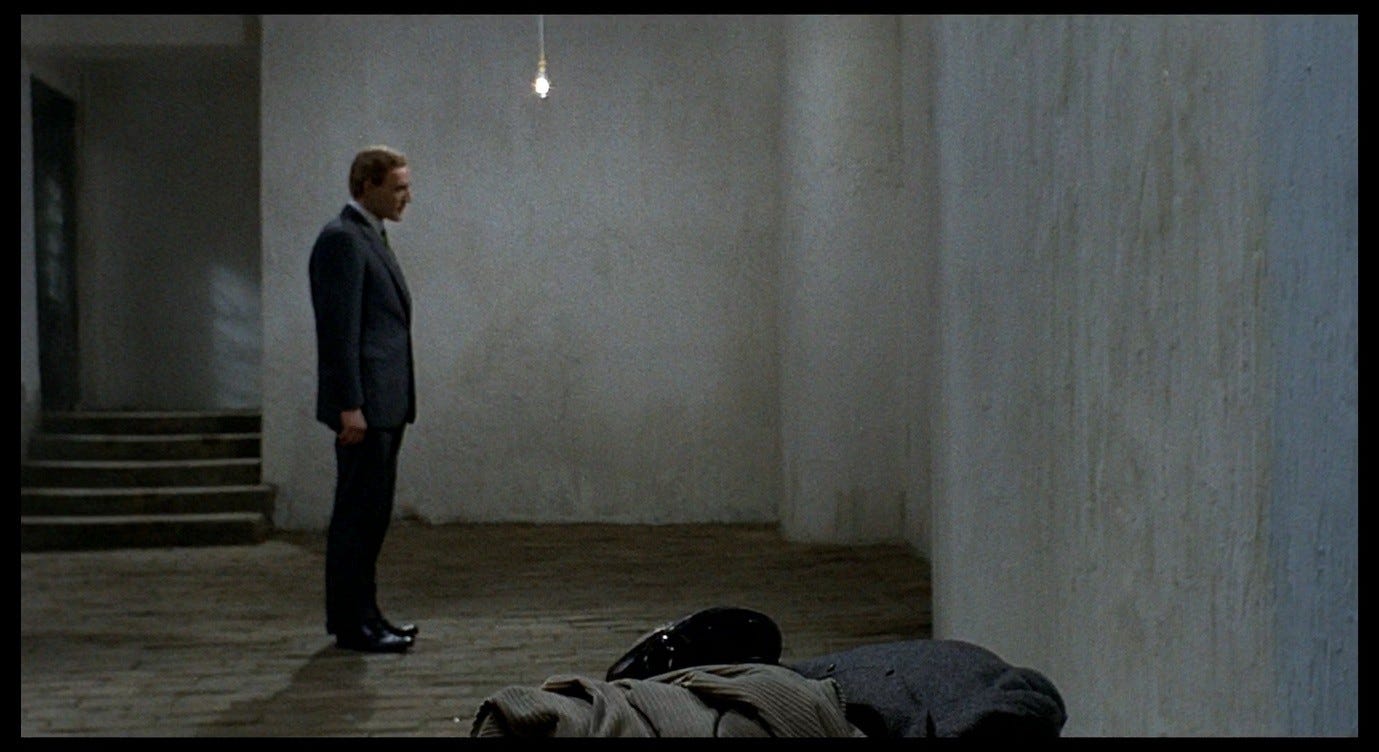
When Corrado asked Giuliana what she planned to do next (dimmi che intenzioni hai) and she replied, ‘Nothing,’ he responded, ‘But that’s absurd!’ in a tone of near-outrage. This woman is in such a state of crisis, she is in so much danger, and yet she proposes to do nothing. To use Camus’s terms, there is a disproportion between her apathetic intention and the high-stakes reality she is facing, or between the verdict dictated by the facts (‘get help’) and the one she arrives at (‘do nothing’). The confrontation Camus describes was visualised in the profile shot of Corrado looking at an empty space on the right-hand side of the frame. Giuliana was (absurdly) replaced with the ‘nothing’ she spoke of.
Throughout the film, Giuliana’s problem has been defined in terms of contradiction. She feels both connected to and alienated from the world she lives in; she both desires and fears the merging or unification of reality; she wants ‘everything’ but also longs for annihilation. For Camus, the feeling of absurdity can also be defined as the ‘divorce between man and this life, the actor and his setting,’2 or as the confrontation between the irrationality of the world and ‘the wild longing for clarity whose call echoes in the human heart.’3 Camus’s deliberately (confrontationally) absurd declaration, ‘I want everything to be explained to me or nothing,’4 may have been in Antonioni’s mind when he framed Giuliana as a person who ‘wants everything’ and ‘wants nothing’ at the same time. Camus describes ‘the essential passion of man torn between his urge toward unity and the clear vision he may have of the walls enclosing him,’5 and here we may think of Giuliana’s wish to have her loved ones enclosing her like a wall – a dream of unity but also a claustrophobic nightmare.
These contradictions, as Camus says, strand us in ‘those waterless deserts where thought reaches its confines,’6 and whose effects can be fatal:
To say that that climate is deadly scarcely amounts to playing on words. Living under that stifling sky forces one to get away or to stay. The important thing is to find out how people get away in the first case and why people stay in the second case. This is how I define the problem of suicide and the possible interest in the conclusions of existential philosophy.7
Many writers, Camus says, have evoked these stifling deserts:
but how eager they were to get out of them! […] The real effort is to stay there […] and to examine closely the odd vegetation of those distant regions.8
In a sense, Giuliana follows Camus’s advice, rejecting suicide in favour of existential philosophy, choosing to live in the red desert that is killing her, the ‘desert that we must not leave behind.’9 There is something in that ‘must not’ that chimes with Giuliana’s (non) devo statements, a sense of needing to make the correct choice – not that, but this – and specifically of needing to think the correct things. As we will see, however, Giuliana’s philosophy (like Antonioni’s film) lacks the sublime tone of Camus’s imperative. She has little sense of being engaged in a significant or heroic endeavour.
For Camus, the ‘unceasing struggle’ of remaining in the waterless desert of the absurd is also, paradoxically, a way of rejecting and rebelling against it:
that struggle implies a total absence of hope (which has nothing to do with despair), a continual rejection (which must not be confused with renunciation), and a conscious dissatisfaction (which must not be compared to immature unrest). Everything that destroys, conjures away, or exorcises these requirements (and, to begin with, consent which overthrows divorce) ruins the absurd and devaluates the attitude that may then be proposed. The absurd has meaning only in so far as it is not agreed to.10
Camus also defines the absurd as
that divorce between the mind that desires and the world that disappoints, my nostalgia for unity, this fragmented universe, and the contradiction that binds them together.11
There is a divorce but also a binding-together; a rejection of something one does not renounce; a hopelessness that does not fall into despair and suicide. Suicide would be a kind of acceptance: ‘suicide settles the absurd,’ Camus says, whereas ‘Living is keeping the absurd alive. Keeping it alive is, above all, contemplating it.’12 To know the ‘logic and integrity’ of the absurd means refusing to take the final, suicidal leap, but living in the ‘subtle instant that precedes the leap. Being able to remain on that dizzying crest – that is integrity and the rest is subterfuge.’13
Giuliana attempts suicide and she attempts to flee her home, but ultimately does not complete either ‘leap’. She remains on the crest, staring down into the void that she can neither accept nor renounce. Her conclusion, ‘Everything that happens to me is my life,’ recalls Camus’s invocation of phenomenology (and Edmund Husserl’s theory of ‘intentionality’) as a way of understanding the spirit of the absurd:
phenomenology declines to explain the world, it wants to be merely a description of actual experience. It confirms absurd thought in its initial assertion that there is no truth, but merely truths. From the evening breeze to this hand on my shoulder, everything has its truth. Consciousness illuminates it by paying attention to it. Consciousness does not form the object of its understanding, it merely focuses, it is the act of attention, and, to borrow a Bergsonian image, it resembles the projector that suddenly focuses on an image. The difference is that there is no scenario, but a successive and incoherent illustration. In that magic lantern all the pictures are privileged. […] It aims to enumerate what it cannot transcend. It affirms solely that without any unifying principle thought can still take delight in describing and understanding every aspect of experience.14
There is a connection between this metaphor (of the projector focusing on an image but also somehow privileging all images) and the telephoto-lens shots in Red Desert, especially those that isolate Giuliana’s head in the foreground as she looks out at her blurry surroundings, or those that blur all the images in front of the lens (de-privileging them all, so to speak).
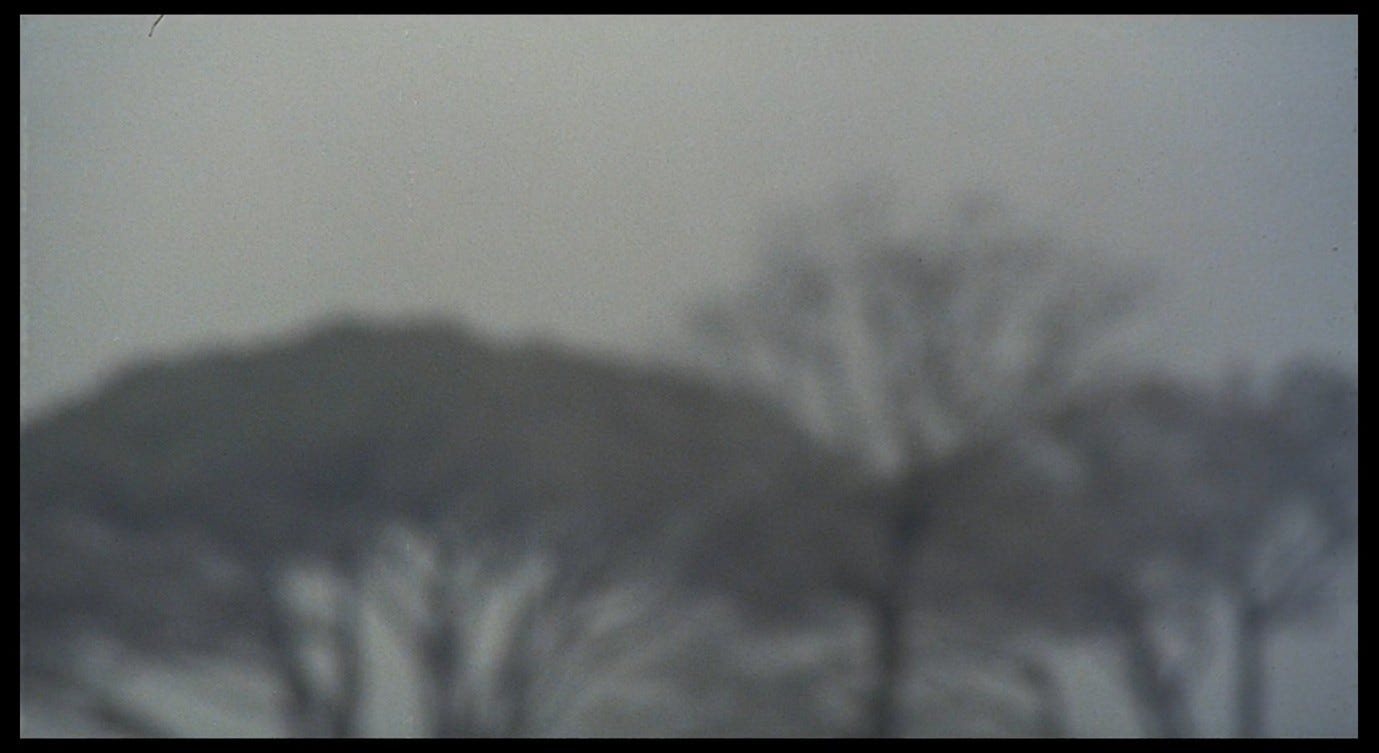
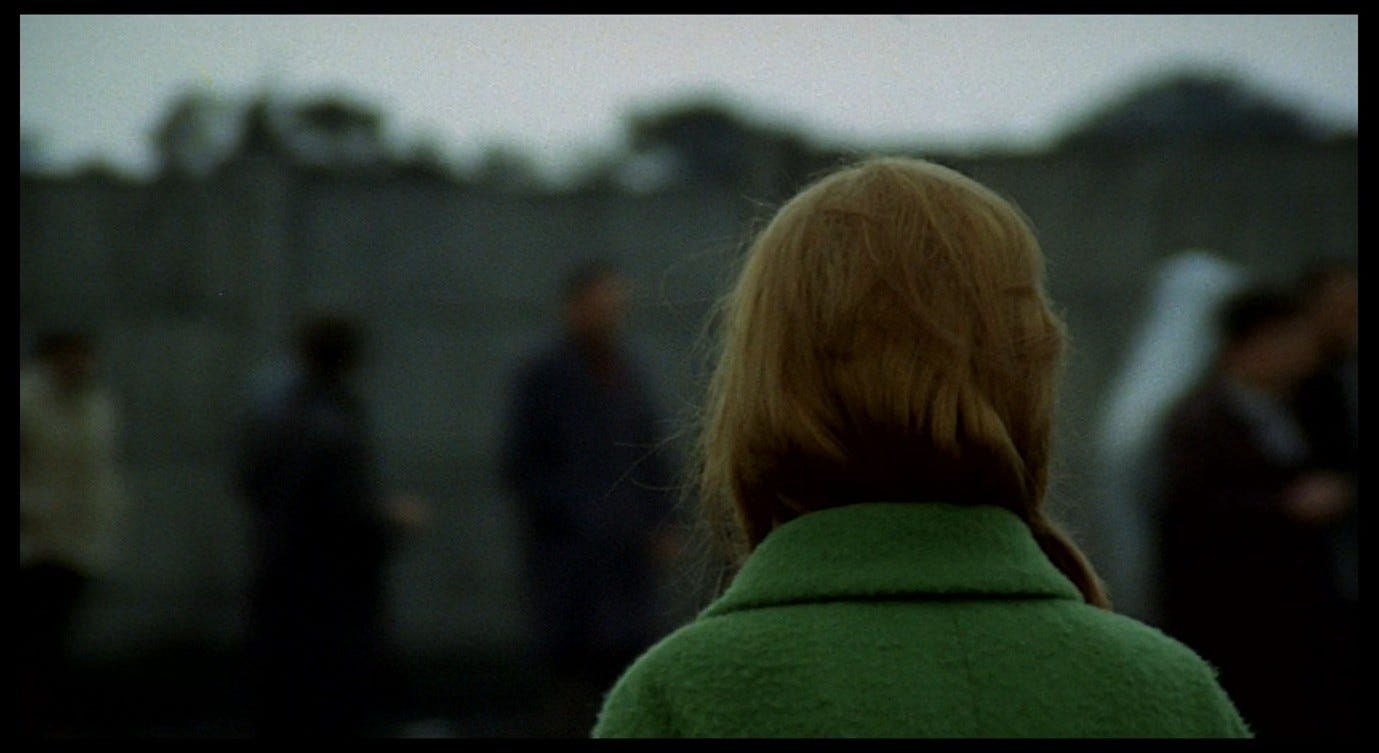
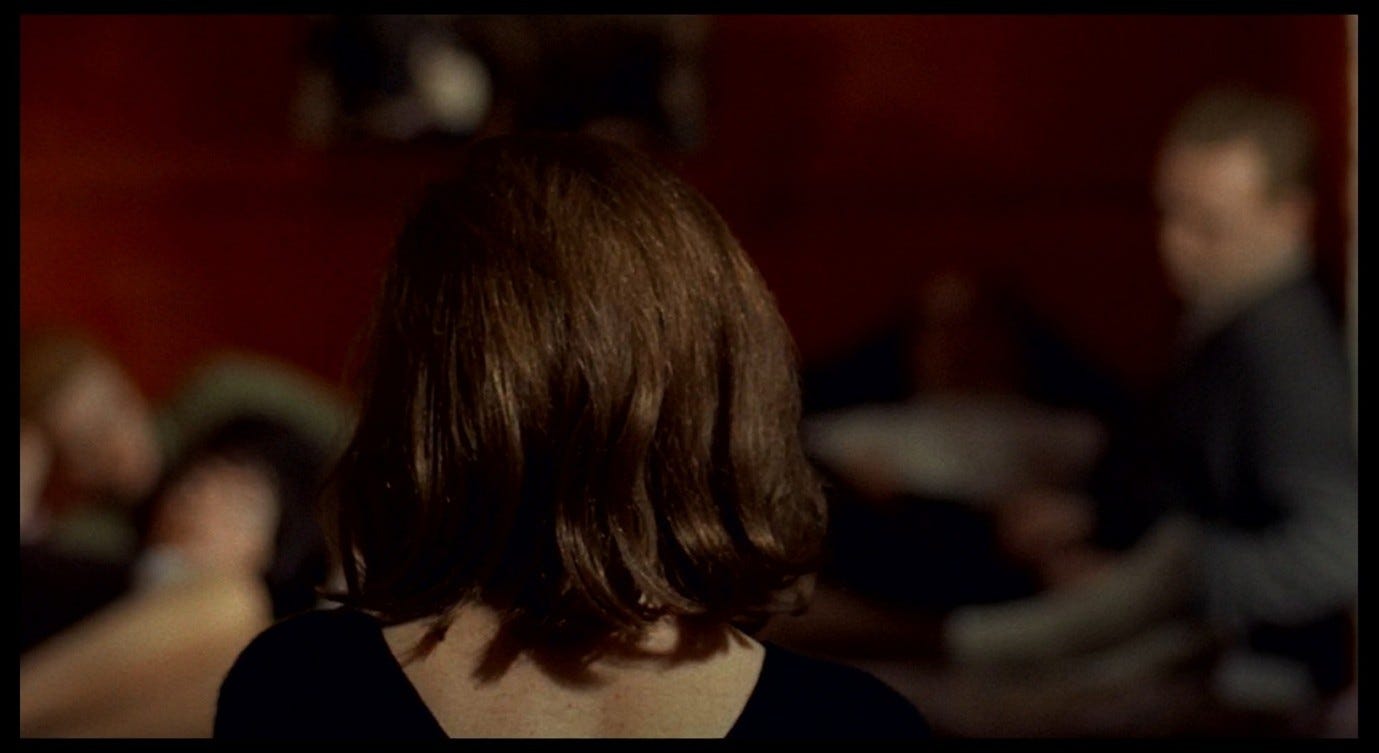
The psychological attitude ‘by which reality is drained instead of being explained,’15 in which there is no single truth but merely truths, is like Giuliana’s refusal to love one thing at a time, her insistence on loving all things at once, and (what may be) her ultimate stance of loving nothing.
There is perhaps an allusion to Husserl’s ‘intentionality’, and to Camus’s alignment of intentionality with the absurd, when Corrado asks about Giuliana’s intenzioni and calls her passivity assurdo. It is indeed in the spirit of the absurd for Giuliana to be aware of the ‘terrible thing in reality,’ aware of her own inability to find out what it is, and yet persistently engaged in living with it. As Camus says:
I don’t know whether this world has a meaning that transcends it. But I know that I do not know that meaning and that it is impossible for me just now to know it. What can a meaning outside my condition mean to me? I can understand only in human terms. What I touch, what resists me – that is what I understand.16
Giuliana complains that the doctors mi parlano di me, that they explain her ‘self’ to her, but it is when she is alone (sola) that she finds herself in danger. She too might protest, ‘What can a meaning outside my condition mean to me?’ But there is a telling distinction between the transcendent unity and meaning that Camus cannot find in the world, and the ‘terrible thing’ that Giuliana cannot identify in reality. Whereas he burns with an unquenchable nostalgia for some kind of absolute meaning, her desire transitions quickly into horror, and her contact with tangible things does not prompt a feeling of comprehension (‘that is what I understand’) but is instead a nightmare that assails her from all angles (‘streets, factories, colours, people, everything!’).
Camus goes on to describe the spirit of the absurd in terms of a prisoner awaiting execution:
I know that in order to keep alive, the absurd cannot be settled. It escapes suicide to the extent that it is simultaneously awareness and rejection of death. It is, at the extreme limit of the condemned man’s last thought, that shoelace that despite everything he sees a few yards away, on the very brink of his dizzying fall. The contrary of suicide, in fact, is the man condemned to death.17
The condemned man’s sensitivity to objects in his environment is, in some way, contingent on his imminent demise. Noticing the shoelace is his way of saying, ‘Everything that happens to me is my life,’ of acknowledging that his life is about to reach its extreme limit, but rejecting death through that one last-minute experience. Everything, even the shoelace he catches sight of, is his life.
Meursault, the protagonist of Camus’s L’étranger (sometimes translated as The Outsider but referred to here as The Stranger), experiences something similar in prison while awaiting execution. He remembers his bedroom and, in his mind’s eye, ‘notices’ every object and every detail in that remembered environment, finally concluding that ‘even after a single day’s experience of the outside world a man could easily live a hundred years in prison.’18 He exemplifies the simultaneous awareness and rejection of death that Camus describes in Sisyphus. As Meursault says towards the end of the novel:
I was sure of myself, sure about everything […] sure of my present life and of the death that was coming. That, no doubt, was all I had; but at least that certainty was something I could get my teeth into – just as it had got its teeth into me.19
In his final hours, he formulates his own version of ‘Everything that happens to me is my life’:
From the dark horizon of my future a sort of slow, persistent breeze had been blowing toward me, all my life long, from the years that were to come. […] I laid my heart open to the benign indifference of the universe.20
There is a sense of triumphant liberation in this ending, a consummation of that longing for unity that Camus himself described as unattainable. The universe is indifferent but benign, and laying one’s heart open to it seems like a way of transcending into that slow, persistent cosmic breeze.
It is clear that Camus sees Meursault – this ostensibly despised, destroyed figure – as a heroic embodiment of the absurd. As he argues in Sisyphus:
The absurd man can only drain everything to the bitter end, and deplete himself. The absurd is his extreme tension, which he maintains constantly by solitary effort, for he knows that in that consciousness and in that day-to-day revolt he gives proof of his only truth, which is defiance.21
Reality is there to be drained and depleted, not explained. It is in this ‘indifference to the future and desire to use up everything that is given’ that one can find liberation; one substitutes ‘the quantity of experiences for the quality,’ and concludes that ‘what counts is not the best living but the most living.’22 If life is simply ‘everything that happens,’ the absurd ideal is to notice as many shoelaces as possible (so to speak) on the way to the guillotine. The parallels with Giuliana are as obvious as the contrasts: she lacks Meursault’s certainty in the present life and approaching death; her universe is indifferent but not benign; and though there is a certain defiance in her draining of reality and self-depletion, there is little of Camus’s triumphant ‘revolt’ in her apologetic retreat at the end of Red Desert.
Once again, we can turn to Robert Musil’s The Man Without Qualities for a closer analogue to Giuliana. In the following passage, we hear Ulrich’s musings on the mingled sense of anxiety and empowerment that attends the proliferation of ‘experiences’ in the modern world:
In the country, [Ulrich] thought […] [a] man matters, his experiences matter, but in the city, where experiences come by the thousands, we can no longer relate them to ourselves; and this is of course the beginning of life’s notorious turning into abstraction.
But even as he thought all this, he was also aware of how this abstraction extended a man’s powers a thousandfold. […] And in one of those apparently random and abstract thoughts that so often assumed importance in his life, it struck him that when one is overburdened and dreams of simplifying one’s life, the basic law of this life, the law one longs for, is nothing other than that of narrative order [ordine narrativo], the simple order that enables one to say: ‘First this happened and then that happened….’ It is the simple sequence of events in which the overwhelmingly manifold nature of things is represented, in a unidimensional order, as a mathematician would say, stringing all that has occurred in space and time on a single thread, which calms us; that celebrated ‘thread of the story,’ [quel famoso filo del racconto] which is, it seems, the thread of life itself. Lucky the man who can say ‘when,’ ‘before,’ and ‘after’! Terrible things may have happened to him, he may have writhed in pain, but as soon as he can tell what happened in chronological order, he feels as contented as if the sun were warming his belly. This is the trick the novel artificially turns to account: Whether the wanderer is riding on the highway in pouring rain or crunching through snow and ice at ten below zero, the reader feels a cozy glow, and this would be hard to understand if this eternally dependable narrative device, which even nursemaids can rely on to keep their little charges quiet, this tried-and-true ‘foreshortening of the mind’s perspective [accorciamento prospettico dell’intelligenza]’ were not already part and parcel of life itself. Most people relate to themselves as storytellers. [Nella relazione fondamentale con se stessi, quasi tutti gli uomini sono dei narratori.] They usually have no use for poems, and although the occasional ‘because’ or ‘in order that’ gets knotted into the thread of life, they generally detest any brooding that goes beyond that; they love the orderly sequence of facts because it has the look of necessity, and the impression that their life has a ‘course’ is somehow their refuge from chaos. It now came to Ulrich that he had lost this elementary, narrative mode of thought [quell’epica primitiva] to which private life still clings, even though everything in public life has already ceased to be narrative and no longer follows a thread [filo], but instead spreads out as an infinitely interwoven surface.23
That ‘fundamental relationship with the self’ is supposed to operate through story-telling, as is the relationship between our intelligenza and the world we engage with. The tried-and-true foreshortening of the mind’s perspective is like the conventional grammar of cinema: the wide shot establishes a clear, coherent setting, then the long-lens shot singles out the main character and frames them beautifully against a world that seems a little vague compared to them. Both the protagonist and the viewer are in safe hands, and we feel a ‘cozy glow’ as we watch the story unfold.
But Red Desert’s narrative does not unfold so reassuringly, and Giuliana, like Ulrich, has little sense of the ‘thread’ of her life. Antonioni came up with this docklands sequence when (in the absence of Richard Harris) the originally scripted ending became impossible to film.24 That unforeseeable misfortune broke the thread of Red Desert, but perhaps Antonioni preferred this revised sequence because it captured so well that loss of what Musil’s Italian translator called the epica primitiva. Nothing could be less epic or less like a hero’s journey than the life of Giuliana, which is simply constituted by ‘everything that happens.’ In the way she is filmed, in the way she is situated in her environment, and in the arrangement of events that befall her, Giuliana is differentiated from the story-hero (imagined by Ulrich) braving rough weather but bound towards a redemptive or at least cathartic finale. Ulrich is a man without qualities in part because his life is without ordine narrativo. As with Giuliana’s dissolving environment, this creates a sense of prevailing abstraction, but in some strange way this abstraction also ‘extends his powers a thousandfold.’
The phrase ordine narrativo makes me think of Identification of a Woman, in which Ida leaves Niccolò for the man she describes as her ordine, and Niccolò at last returns to the work of developing his film – a film that seems incapable of finding its own ordine, its narrative structure. Antonioni tends to eschew the famoso filo del racconto in favour of the filo pericoloso delle cose, the ‘dangerous thread of things.’ In a story with that title, Antonioni reflects on the process by which his nebulous ideas gestate into films:
What I don’t know when I’m asked how a film is born is precisely how the birth itself – the delivery, the ‘big bang,’ the first three minutes – takes place. And whether the images of those first three minutes have an inner life of their own. In other words, whether a film originates as a response to an inner need of its author or whether the question asked by those images is destined to be nothing more than a question [destinata a non essere niente di piú], to have value – ontologically – for what it is.25
If the opening images propose a question, this implies that what follows will respond to that question, but if that question is destined to be niente di più (not even ‘nothing more than a question’), perhaps it ceases to be a question. It leads to no answer, no follow-up, it just hangs there in defiant isolation.
Later in the story, Antonioni takes those initial images and the question they seem to ask, and tries to string them into a coherent thread:
[T]he unconsciousness with which the film was coming into being would never amount to anything unless I impose limits. In other words, the moment’s come to organise the ideas, […] [t]o think of the subject in terms of articulating the scenes, of beginning, development, and end, in short, of structure. […] Roland Barthes says that a work’s meaning can’t be created on its own [non può farsi da solo], that the author can produce only conjectures of meaning, of forms if you like, and it’s the world that fills them.
But how can Barthes rely on so uncertain [malsicura] an entity as the world?26
This passage challenges the opening paragraph: of course a film has to originate from the inner life of the author, and of course that same author has to give it structure and meaning. When Barthes says the artwork cannot have meaning da sola, he means that the artist cannot craft something with a definitive, intended, self-contained meaning; the artwork’s senso will be supplied by the world that receives it. But, Antonioni asks, how can an artist rely on the world to provide that meaning? He cannot help trying to organise his ideas into something meaningful because he fears that otherwise they will ‘amount to nothing.’
And yet the story’s final paragraph undercuts this insistence on authorial control:
The odd thing is that this subject, born years ago, is ideally situated after another written later. […] All of which implies that, if it’s only cause and effect [la casualità] that set this event after the other in my mind, then it’s necessary to acknowledge in mental events [avventure mentali] the same movements and mechanisms that coordinate (or disconnect [scardinano]) the real events [avventure reali] of our lives.27
The word casualità connotes something less orderly than the ‘cause and effect’ of Arrowsmith’s translation. We are in the realm of avventure, like the inexplicable events of L’avventura that do not necessarily constitute an ordine narrativo. Perhaps the film-maker’s job – or at least this film-maker’s job – is not to recount an epica primitiva that reassures the audience, in which even the first three minutes accomplish that accorciamento prospettico dell’intelligenza that Ulrich referred to: the ‘prospective shortening of the understanding,’ the sense we have at the beginning of a story that we know how it will end. The narrator of Jean-Paul Sartre’s Nausea also describes this longed-for foreshortening:
[F]or the most commonplace event to become an adventure, you must – and this is all that is necessary – start recounting it. This is what fools people: a man is always a teller of tales, he lives surrounded by his stories and the stories of others, he sees everything that happens to him through them; and he tries to live his life as if he were recounting it. […] When you are living, nothing happens. The settings change, people come in and go out, that’s all. There are never any beginnings. Days are tacked on to days without rhyme or reason, it is an endless, monotonous addition. […] That’s living. But when you tell about life, everything changes. […] The [opening sentence of the story] is tossed off casually, it seems superfluous; but we refuse to be taken in and we put it aside: it is a piece of information whose value we shall understand later on. And we have the impression that the hero lived all the details of that night like annunciations, promises, or even that he lived only those that were promises, blind and deaf to everything that did not herald adventure. We forget that the future was not yet there; the fellow was walking in a darkness devoid of portents, a night which offered him its monotonous riches pell-mell, and he made no choice.28
When Antonioni wonders whether the opening moments of his film have a life of their own, whether the question proposed by an image has an inherent value even if it is never answered, and whether the world can be trusted to fill in that absent meaning, he is pitting the famoso filo del racconto against the filo pericoloso delle cose. Is there really a story here? Is this really an adventure? Or are we just trapped in the habit of seeing ‘everything that happens’ through story-coloured, adventure-shaped glasses? Is life just a heap of ‘monotonous riches’ to which we ascribe structure and meaning? Do we invest in the tried-and-true narrative order, or do we face the danger – the ‘something terrible’ – in the thread that connects one thing to another?
Giuliana, in the shipyard, is ‘walking in a darkness devoid of portents,’ and she ‘makes no choice.’ ‘It’s not that I have decided,’ she tells the sailor. ‘I cannot decide because I am not a donna sola.’ Like the work of art that is subject to the world’s impositions, she has no fixed meaning or qualities in herself. Her life, such as it is, consists of the things that happen to her. She acknowledges her subjection to that casualità that Antonioni describes as ‘coordinating or disconnecting’ the avventure of our life. The verb he uses for ‘disconnect’ is scardinare, literally ‘to unhinge’: the randomness of existence can seem to join things together or rip those joints apart, and whether it does one or the other may depend on how we interpret it. As we will see, it becomes even clearer in Camus’s The Rebel that he is far more invested in the connective force of casualità and absurdity – and in the sense of community they can engender between people – than Antonioni, who challenges us to see that sense of community as an artificial hinge that can easily be dismantled. Accepting this challenge entails something more complex than nihilistic despair. Ulrich felt that his powers were multiplied by the onset of abstraction, as though the unsettling realisation that ‘the bodies are separated’ might also be liberating in some ways. For Giuliana, too, the refusal of a redemptive or tragic ending may lend her a kind of power not often wielded by fictional characters.
Next: Part 49, The artist and reality.
View the Contents post to browse the full series.
Follow me on BlueSky and/or Twitter.
Camus, Albert, The Myth of Sisyphus (1942), trans. Justin O’Brien (London: Penguin, 2013), p. 15
Camus, Albert, The Myth of Sisyphus (1942), trans. Justin O’Brien (London: Penguin, 2013), p. 10
Camus, Albert, The Myth of Sisyphus (1942), trans. Justin O’Brien (London: Penguin, 2013), p. 17
Camus, Albert, The Myth of Sisyphus (1942), trans. Justin O’Brien (London: Penguin, 2013), p. 22
Camus, Albert, The Myth of Sisyphus (1942), trans. Justin O’Brien (London: Penguin, 2013), p. 18
Camus, Albert, The Myth of Sisyphus (1942), trans. Justin O’Brien (London: Penguin, 2013), p. 9
Camus, Albert, The Myth of Sisyphus (1942), trans. Justin O’Brien (London: Penguin, 2013), p. 23
Camus, Albert, The Myth of Sisyphus (1942), trans. Justin O’Brien (London: Penguin, 2013), p. 10
Camus, Albert, The Myth of Sisyphus (1942), trans. Justin O’Brien (London: Penguin, 2013), p. 22
Camus, Albert, The Myth of Sisyphus (1942), trans. Justin O’Brien (London: Penguin, 2013), p. 24
Camus, Albert, The Myth of Sisyphus (1942), trans. Justin O’Brien (London: Penguin, 2013), p. 37
Camus, Albert, The Myth of Sisyphus (1942), trans. Justin O’Brien (London: Penguin, 2013), p. 40
Camus, Albert, The Myth of Sisyphus (1942), trans. Justin O’Brien (London: Penguin, 2013), p. 38
Camus, Albert, The Myth of Sisyphus (1942), trans. Justin O’Brien (London: Penguin, 2013), p. 33
Camus, Albert, The Myth of Sisyphus (1942), trans. Justin O’Brien (London: Penguin, 2013), p. 33
Camus, Albert, The Myth of Sisyphus (1942), trans. Justin O’Brien (London: Penguin, 2013), p. 38
Camus, Albert, The Myth of Sisyphus (1942), trans. Justin O’Brien (London: Penguin, 2013), p. 41
Camus, Albert, The Stranger (1942), trans. Stuart Gilbert (1946) (Philadelphia: R. P. Pryne, 2015), Kindle edition, loc. 1072
Camus, Albert, The Stranger (1942), trans. Stuart Gilbert (1946) (Philadelphia: R. P. Pryne, 2015), Kindle edition, loc. 1660
Camus, Albert, The Stranger (1942), trans. Stuart Gilbert (1946) (Philadelphia: R. P. Pryne, 2015), Kindle edition, loc. 1696
Camus, Albert, The Myth of Sisyphus (1942), trans. Justin O’ Brien (London: Penguin, 2013), p. 41
Camus, Albert, The Myth of Sisyphus (1942), trans. Justin O’ Brien (London: Penguin, 2013), p. 45
Musil, Robert, The Man Without Qualities (1930-1943), trans. Sophie Wilkins (Basingstoke: Pan Macmillan, 2017), p. 947. Italian text from L’uomo senza qualità, trans. Anita Rho, Gabriella Benedetti, and Laura Castoldi, ed. Adolf Frisé (Torino: Einaudi, 1997), pp. 856-857.
‘Antonioni discusses The Passenger’, in The Architecture of Vision, ed. Carlo di Carlo and Giorgio Tinazzi; American edition by Marga Cottino-Jones (Chicago: University of Chicago Press, 1996), pp. 333-343; p. 343. See Part 45.
Antonioni, Michelangelo, ‘The dangerous thread of things’, in That Bowling Alley on the Tiber (Oxford: Oxford University Press, 1986), trans. William Arrowsmith, pp. 143-150; p. 145. Italian text from ‘Il filo pericoloso delle cose’, in Quel bowling sul Tevere (Torino: Einaudi, 1983), pp. 159-166; p. 161.
Antonioni, Michelangelo, ‘The dangerous thread of things’, in That Bowling Alley on the Tiber (Oxford: Oxford University Press, 1986), trans. William Arrowsmith, pp. 143-150; p. 148. Italian text from ‘Il filo pericoloso delle cose’, in Quel bowling sul Tevere (Torino: Einaudi, 1983), pp. 159-166; p. 165.
Antonioni, Michelangelo, ‘The dangerous thread of things’, in That Bowling Alley on the Tiber (Oxford: Oxford University Press, 1986), trans. William Arrowsmith, pp. 143-150; p. 150. Italian text from ‘Il filo pericoloso delle cose’, in Quel bowling sul Tevere (Torino: Einaudi, 1983), pp. 159-166; p. 166.
Sartre, Jean-Paul, Nausea (1938), trans. Robert Baldick (London: Penguin, 1990), pp. 46-48
This series is legendary